
Jumping into options without a plan is a recipe for disaster. I've seen it happen time and time again. That's why paper trading is a non-negotiable first step. Think of it as your personal flight simulator for the markets—a place to test your wings and learn the controls before you're flying with real money.
Why Paper Trading Is Your First Smart Move in Options

The world of options is exciting, no doubt. But the sheer complexity of the contracts, strategies, and market swings can overwhelm anyone just starting out. This is exactly where paper trading proves its worth. It’s not just about "practice"—it's about building a solid, repeatable process you can rely on when the pressure is real.
The biggest advantage? It’s a zero-consequence sandbox. This is your chance to get a feel for different strategies, like swing trading, or hone your skills at spotting channeling stocks without the gut-wrenching fear of making a costly mistake.
Build Discipline Before You Risk Capital
Successful trading is as much about mindset as it is about strategy. Paper trading gives you the space to build the mental discipline you need to succeed. When you remove the fear of losing money, you can focus purely on your decision-making process and the mechanics of placing trades. This helps you build a foundation of discipline that's absolutely critical for managing risk and overcoming the hesitation that plagues so many new traders.
Think about the key habits you'll build in a practice account:
- Learning Your Platform: Every brokerage has its own layout and quirks. Paper trading lets you master order entry, navigate option chains, and use analysis tools until it becomes second nature. No fumbling around when a real opportunity pops up.
- Testing Your Strategies: You can experiment with everything from simple calls and puts to more complex spreads. This is where you figure out what truly fits your style and risk tolerance without any financial fallout.
- Gaining Real Confidence: Nothing builds confidence like seeing your trades play out successfully. Managing a few winning paper trades gives you the self-assurance you need to pull the trigger when your analysis points to a genuine opportunity.
A Modern Take on an Old Practice
The idea isn't new. Back in the 70s and 80s, aspiring traders would literally scribble their "buy" and "sell" orders on paper pads, tracking their hypothetical portfolio against the day's market prices. Today’s platforms just simulate this process with incredible, real-time accuracy.
The goal isn't just to learn how to paper trade options. It's to use the process to hammer out and refine a personal trading plan. You're turning theory into muscle memory.
Yet, you might be surprised how many people skip this step. A fascinating study from Alpaca Markets revealed that a staggering 67.2% of new traders dive straight into live trading, completely bypassing the practice phase. Of the 32.8% who did use a paper account, 75.1% went live within just 60 days. This tells me that most people treat it as a quick check of the platform, not a serious training ground.
This zero-risk environment is the perfect bridge between knowing the theory and actually having the skill to apply it. You can explore our complete guide on how to practice trading for more detailed examples. Ultimately, paper trading ensures your first real trade is an educated one, not a gamble.
Choosing Your Paper Trading Platform
Before you place a single trade, you have to pick your playground. This decision matters more than you might think. The right paper trading platform will feel like a flight simulator, preparing you for the real deal. The wrong one is more like an arcade game—fun, but it teaches you all the wrong habits.
Your mission is to find a simulator that mirrors the live market as closely as possible. This makes the eventual switch to trading with real money feel like a small step, not a giant leap.
Thankfully, many of the best brokerages offer powerful paper trading accounts, often for free. For anyone serious about learning options, I almost always point them toward two major players: thinkorswim (now part of Charles Schwab) and Interactive Brokers (IBKR).
These aren't just simulators; they're the full-blown professional platforms with a "paper" switch. They give you the sophisticated tools you need to actually learn, not just click buttons.
What to Look For in a Platform
When you're vetting platforms, you have to be picky. Some "paper trading" accounts are so simplified they're useless for serious practice. You need a setup that treats your practice with respect.
Here are the non-negotiables:
- Realistic Order Fills: This is critical. The simulator must understand liquidity. If you place a market order on a thinly traded option, it shouldn't fill instantly at a perfect price. A good platform will simulate the delays and slippage you'd face in the real market.
- Deep Market Data: You can't fly blind. You need real-time quotes, full option chains, and the ability to see the bid-ask spread and volume. This data is the lifeblood of any trading decision.
- Advanced Analysis Tools: Options are all about the "what ifs." Your platform must let you model strategies, chart volatility, and, most importantly, track the Greeks (Delta, Gamma, Theta, Vega) in real-time.
The best paper trading platform is almost always the one you plan to use for live trading. Get familiar with its quirks, order entry, and tools now, so you aren't fumbling around when your own money is on the line.
Setting Up Your Account for Realism
Once you've picked your platform, you’ll face your first test of discipline. Most simulators will start you off with a wildly inflated account balance, like $100,000 or even $1 million.
Your first move? Change it. Immediately.
Trading a $100,000 paper account when you plan to go live with $10,000 is the fastest way to learn how to lose money. It encourages reckless position sizing and a total disregard for risk. Set your starting balance to the exact amount you plan to fund your real account with. This one simple tweak forces you to confront realistic constraints from day one.
A well-organized workspace is another key. Take the time to customize your layout so you can see your stock watchlist, open positions, and an option chain all at once. Think of it as setting up your workshop before a project—an efficient setup prevents confusion and leads to much smarter decisions.
To help you decide, here’s a quick look at how some of the top platforms stack up for options paper trading.
Comparing the Best Paper Trading Platforms for Options
This table gives you a head-to-head comparison of key features across popular platforms, helping you choose the best environment for your options practice.
| Platform | Best For | Key Options Features | Realism Score |
|---|---|---|---|
| thinkorswim | All-around analysis and education | OnDemand backtesting, strategy modeling, advanced charting, active community support. | High |
| Interactive Brokers | Global access and low-cost structure | Broad market access, advanced order types, TWS platform is highly customizable. | Very High |
| tastytrade | Options-focused traders | Probability-based tools, quick strategy builders, visually intuitive interface. | Medium-High |
Ultimately, the goal is to create a practice environment so realistic that the only difference on day one of live trading is the feeling in your gut. Choose the platform that gets you closest to that reality.
Finding the Right Stocks and Options to Trade
Let's get one thing straight: a brilliant options strategy on a garbage stock is still a garbage trade. Your success in paper trading begins way before you even look at an options chain. It starts with the underlying stock. For our practice runs, we want stocks that actually have a rhythm—predictable patterns that give us a fighting chance to learn.
The whole point is to stop randomly picking whatever’s hot on Twitter and start building a focused watchlist. We’re hunting for stocks that are "channeling," which is just a trader's way of saying they're bouncing between a clear floor (support) and a ceiling (resistance). These are the absolute best sandboxes for practicing swing trading.
Nearly every trading platform has a stock screener you can use to unearth these gems. You can dial in your filters to find stocks with decent, but not crazy, volatility and a history of respecting those price boundaries. Honestly, building this kind of discipline in how you choose your stocks is a pro-level habit you should start from day one.
Building Your Watchlist with Channeling Stocks
Think of a channeling stock like a tennis ball in a hallway. It hits the floor (support) and bounces up toward the ceiling (resistance), then falls back down. This back-and-forth action gives us clean, repeatable setups to practice our entries and exits.
When you're setting up your screener, here's what I look for:
- Consistent Volume: Make sure the stock trades at least 500,000 shares a day. This is a good sign of liquidity, meaning you can get in and out of your simulated trades without any fuss.
- Clear Support and Resistance: Pull up a daily or weekly chart. The channel should jump out at you. The more times the price has bounced off these levels, the more reliable they are.
- Moderate Volatility: You want to avoid two extremes: sleepy stocks that go nowhere and meme stocks that gap all over the place. We're looking for a steady pulse, not a flatline or a seizure.
By focusing on channeling stocks, you're not just practicing random trades. You're learning to spot high-probability setups—a skill that will make you money long after the hype around some hot stock has faded.
Once you’ve found 5-10 solid candidates for your watchlist, it's time to dig into the options themselves. If you're new to looking at charts, learning how to read stock charts is non-negotiable for finding these patterns.
Selecting the Right Option Contract
Alright, now for the fun part. Imagine one of your watchlist stocks, "XYZ Inc.," is trading at $48. You see on the chart that it just bounced cleanly off a strong support level at $45, and you have good reason to believe it's headed back toward the channel's resistance at $55. You want to practice buying a call option to play that move up.
This is where two critical decisions come into play that will completely shape your trade.
Strike Price: The Cost vs. Probability Tradeoff
The strike price you choose is a constant balancing act between cost and your probability of success.
- In-the-Money (ITM): Picking a strike below the current price, like $45, means the option is already "in the money." These are more expensive, but they move more in lock-step with the stock and have a higher chance of staying profitable.
- Out-of-the-Money (OTM): Choosing a strike above the current price, like $52, gives you a much cheaper option. You get more bang for your buck if you're right, but the stock has to make a big move just for you to break even. It's a riskier bet.
When you're just starting out, a good rule of thumb is to stick with options that are At-the-Money (ATM), right around the current $48 stock price. They offer a great middle ground.
Expiration Date: The Battle Against the Clock
Every option has an expiration date, and its value is constantly melting away. This is called time decay, or Theta. Your job is to pick an expiration that gives your trade idea enough time to actually happen.
- Short-Dated (e.g., 2 weeks out): These are cheap and tempting, but time decay is brutal. If the stock chops around for a week before moving, your option's value can get crushed.
- Longer-Dated (e.g., 2-3 months out): These cost more upfront but give you much more breathing room. The daily time decay is far gentler, making them more forgiving if the stock takes its sweet time.
For a classic swing trade inside a channel, the 30-60 day expiration window is often the sweet spot. It's enough time for the stock to travel from support to resistance without forcing you to overpay for months of unneeded time. In our XYZ example, an option expiring in about 45 days would be a perfect fit.
Putting Your First Paper Trade on the Books
Alright, you’ve done the homework. You have a solid watchlist of channeling stocks and a good grasp on how to pick an option contract. Now comes the most important part of this whole process—actually taking action. This is where you get your hands dirty and start building real skills.
We can break down the hunt for a good trade into a simple, repeatable process. It’s not about random guessing; it's a workflow that takes you from the big picture down to a specific trade.
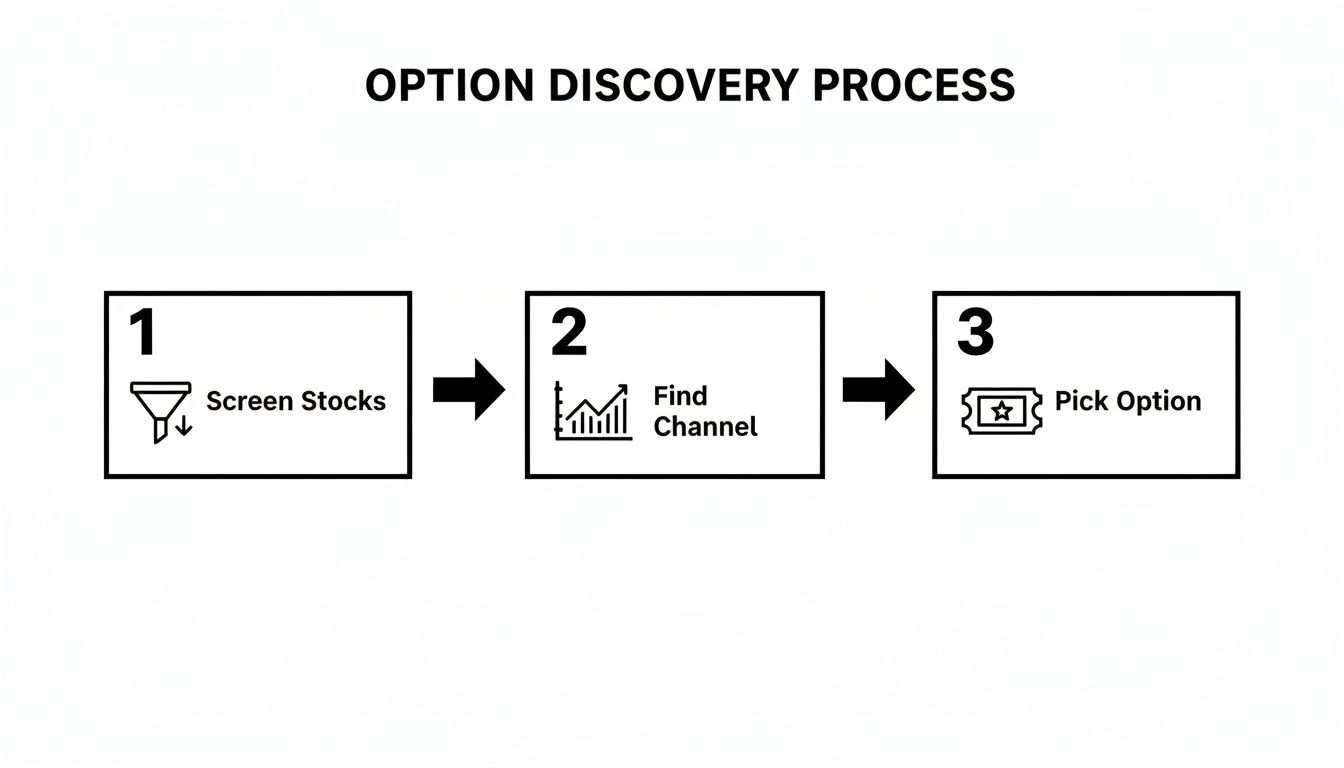
Following a framework like this helps you stay disciplined and ensures you're only putting your (virtual) money on setups that actually meet your criteria.
Placing Your Order The Right Way
Let’s stick with our "XYZ Inc." example. The stock is trading at $48. You've mapped out support at $45 and resistance at $55. Based on this, you've chosen a 45-day call option with a $50 strike price.
When you pull up the option chain, you see the bid-ask spread is $2.40 by $2.50. This simply means buyers are willing to pay $2.40 for the contract, while sellers are asking for $2.50.
You have two basic ways to enter this trade: a Market order or a Limit order.
A market order is the "get me in now" button. It fills instantly at the best available price, which in this case would likely be the ask of $2.50, or maybe even higher if the price moves against you for a split second.
A limit order, on the other hand, is your best friend. It lets you name your price. You could place a limit order at $2.45, splitting the difference between the bid and ask. Your order will only get filled if a seller comes down to meet your price. This control is everything in options.
I can't stress this enough: always use limit orders when trading options. Bid-ask spreads can be wide, and blindly hitting the market order is a rookie mistake that guarantees you're overpaying to get into a trade.
Managing the Trade Once You’re In
Success! Your limit order at $2.45 filled, and you now own the $50 call on XYZ. So, what’s next? The real work actually starts after you buy. Your job now is to actively manage the position and see if your original thesis plays out.
This means you need to be tracking two main things:
- The Stock's Price Action: Is XYZ bouncing off that support level like you predicted? Or is it just sitting there, or worse, starting to drop? The stock's chart is your number one indicator.
- The Greeks: You'll want to keep an eye on Delta and Theta. Delta will give you a rough idea of how much your option's price will move for every $1 change in the stock. Theta is the enemy—it shows you how much value time decay is eating away from your option each day.
Your platform will show you these numbers right in your position statement. Watching how they react to the stock’s movement gives you a much deeper understanding of why your P&L is changing. If the stock stalls, you'll literally see Theta bleed your profits away.
Knowing When to Get Out
You need an exit plan before you even think about getting in. Since your whole trade was based on the stock moving between its $45 support and $55 resistance, your exit triggers should be tied directly to those levels.
- Profit Target: As XYZ gets close to that $55 resistance zone, that's your cue to start thinking about taking profits. You don't have to wait for the exact number; getting close is often good enough.
- Stop-Loss: What if the trade moves against you? If XYZ breaks below your $45 support level, your reason for entering the trade is officially invalid. That's your signal to cut the position and accept the small loss.
Let's imagine things go well and XYZ rallies to $54. Your option is now priced at $4.00, giving you a fantastic paper profit. This is the perfect time to close the position and lock in that win.
But what if the stock is moving in your favor, but slowly, and your expiration date is getting a little too close for comfort? If your analysis still holds up, you could "roll" the position. This is a common tactic where you sell your current option (to lock in the profit) and immediately buy a new one with a later expiration date. This gives your trade more time to work.
To see how these scenarios play out with different stocks and strategies, check out these paper trading examples. The repetition is what builds the confidence you'll need when real money is on the line.
Analyzing Your Performance to Find Your Edge

Let's be blunt: placing practice trades is only half the work. If you’re not digging into your results and breaking down your decisions, you’re not really learning. You're just clicking buttons. This is the part of the process where you turn simple practice into a powerful learning engine that reveals your unique trading edge.
Winning traders aren't just market wizards; they're masters of self-analysis. The goal here is to get way beyond your P/L. You need to understand the why behind every single win and loss, and that’s only possible if you’re keeping honest records.
Your Most Powerful Tool: The Trading Journal
A trading journal is the single most important tool you'll have as a developing trader. It's so much more than a spreadsheet of wins and losses—it's a detailed log of your mindset, your emotions, and the market story that led you to take a trade.
This record becomes your personal trading database. Over time, it will shine a light on profitable patterns (and bad habits) you’d never spot otherwise. Capturing this context is absolutely essential when learning to paper trade options, because the "why" you did something is often more valuable than the "what."
Your entries need to tell the whole story. What was your original idea? Why did you pick that specific strike and expiration date? How did you feel when you put the trade on—confident, nervous, or maybe a little bit of FOMO?
I’ve seen countless new traders ignore journaling, and it’s a huge mistake. A well-kept journal is your accountability partner, your mentor, and your statistical database all rolled into one. Here’s a simple but effective template to get you started on the right foot.
Your Essential Trading Journal Template
Use this structured template to track every paper trade, analyze your performance, and turn mistakes into valuable lessons.
| Date | Underlying Stock | Strategy (e.g., Buy Call) | Entry Price | Exit Price | Profit/Loss | Reason for Trade | Lessons Learned |
|---|---|---|---|---|---|---|---|
| 03/15/2026 | ABC | Buy 150 Call (Apr 19 Exp) | $2.50 | $3.75 | +$125 | Stock bouncing off 50-day MA; strong sector momentum. | Patience paid off. Waited for the setup instead of forcing a trade. |
| 03/18/2026 | XYZ | Sell 95 Put (Mar 28 Exp) | $1.10 | $2.20 | -$110 | Tried to catch a falling knife. Ignored bearish signals. | Don't fight the trend. Stick to the plan and respect stop-losses. |
By filling this out for every single trade—no exceptions—you start building the data you need to find out what actually works for you.
The Non-Negotiable Weekly Review
At the end of every week, block out an hour for a "weekly review." Treat this time as sacred. It's your opportunity to step back from the daily noise and see the bigger picture of your trading performance.
During this review, ask yourself some hard questions:
- Did I actually follow my trading plan for every trade? If not, why?
- What was my single biggest mistake this week, and what led me to make it?
- Which strategy or setup felt the most natural and produced the best results?
- Am I cutting my losses quickly, or am I letting losers run in the hope they'll turn around?
This weekly ritual is your defense against building bad habits. Because the money isn't real, it's dangerously easy to get reckless in a paper account. Your review forces you to confront those tendencies and treat your practice with the discipline you'll need when real capital is on the line.
Mining Your Data to Find Your Edge
After a month or two of diligent journaling and consistent reviews, you'll have a goldmine of data on your own performance. Now it’s time to start looking for your "edge"—that specific set of conditions, strategies, or stock behaviors where you consistently make money.
Maybe you’ll discover that 80% of your profits come from buying calls on channeling tech stocks after they pull back to a key moving average. Or you might find you lose money every single time you get tempted by short-dated options right before an earnings report.
This is the entire point of paper trading. You’re not just practicing—you’re doing personal R&D to build a business plan that’s tailored to your strengths.
Once you identify these patterns, you can take real action. Focus more on what works, and create strict, unbreakable rules to avoid the setups that drain your account. This is how you stop gambling and start trading with a clear, data-driven purpose.
A Few Common Questions About Paper Trading Options
As you get started with paper trading options, a few questions always seem to pop up. That’s a good thing. This whole process is about learning, and asking the right questions is half the battle. Let's clear up some of the most common points of confusion I see with new traders.
Think of this as the quick-start guide to getting your head straight before you dive in.
How Long Should I Paper Trade Options Before Using Real Money?
This is, without a doubt, the question I get asked most often. The honest answer? There's no magic number on the calendar. The goal isn't just to pass time; it's to build consistent, disciplined execution.
Forget about a specific number of days. Focus on hitting performance-based milestones instead. For most people, this takes about 60 to 90 days of dedicated, almost daily practice. Can you actually follow your trading plan—every entry, every exit, every stop-loss—without fudging the rules? Do you truly understand why a trade worked or, more importantly, why it failed?
The real sign you're ready for live trading isn't a hot streak of paper profits. It's when you can execute your plan flawlessly over dozens of trades, without letting greed or "what if" scenarios creep in. That’s the muscle memory that will protect your real money.
Once you can prove to yourself that your process is repeatable and sound, you're getting close. The whole point is to build a rock-solid foundation of good habits, not just to race into the live market.
Does Paper Trading Perfectly Replicate Real Options Trading?
Absolutely not, and it’s critical to know the difference. A paper trading account is a fantastic tool for learning your platform's buttons and testing strategies, but it has some serious blind spots. The biggest one is the complete lack of emotional pressure. It's surprisingly easy to be a trading guru when there's no real money at risk.
Here’s where simulation just can't match reality:
- Emotional Stress: Nothing—and I mean nothing—can prepare you for the gut-wrenching feeling of watching your own money evaporate with every tick of the market. Fear and greed are incredibly powerful drivers that simply don't exist in a paper account.
- Order Fills and Slippage: Most simulators give you perfect, instant fills at the exact price you click. In a live market, especially with options that don't trade a lot, you'll run into slippage. That's the gap between the price you wanted and the price you actually got, and it can turn a small winner into a loser.
- Market Impact: This is less of a concern for small retail traders, but placing a large order in the real world can sometimes nudge the price. A simulator doesn't account for this at all.
Think of paper trading as a flight simulator. It’s an essential tool for learning the controls and practicing emergency procedures. But it will never feel like flying through real turbulence with real people on board.
What Is the Biggest Mistake Beginners Make When Paper Trading?
The single most destructive mistake is treating the paper account like a video game. Because there are no consequences, beginners will often take insane risks they’d never dream of with their own cash. They'll throw their entire $100,000 virtual balance on a single, out-of-the-money weekly option, hoping to hit the jackpot.
This kind of behavior is a disaster because it builds the worst possible habits. It trains your brain to completely ignore risk management, position sizing, and all the other rules that keep real traders in the game.
The fix is simple, but it demands discipline: treat your paper account exactly as you would a real one. Start with a realistic account size—whatever you actually plan to fund your live account with. Then, apply strict risk rules, like only risking 1-2% of your total account on any single trade. Your objective here is to practice being a professional, not to chase a meaningless high score.
At Channeling Stocks, we provide a dedicated paper trading environment designed to help you practice with realistic numbers. Our focus on channeling stocks gives you a curated list of assets with predictable patterns, perfect for honing your skills before risking a single dollar. Discover how our research can save you time and help you trade with confidence by starting a two-week free trial today.