
So, when did trading actually begin? The honest answer is that it's as old as humanity itself. Long before we had markets, money, or even written language, people were trading. We're talking about roots that go back over 150,000 years into prehistory, all starting with the simple act of barter.
The Ancient Roots of Barter and Early Exchange
Forget stock tickers and digital charts for a moment. The engine that drives all commerce—even today—is basic human need. In a world without currency, the only way to get something you didn't have was to swap it for something you did. That’s barter in a nutshell, the original economy built on mutual survival.
Think of it this way: one group might have a wealth of sharp flint, perfect for crafting tools, while their neighbors had access to animal hides for making warm clothes. A direct swap of flint for hides wasn't about profit; it was about getting through the next winter. That's the first trade.
Things really kicked into a higher gear with the Agricultural Revolution around 10,000 BCE. For the first time in history, communities could grow more food than they needed to survive. This surplus was the fuel that ignited what we'd recognize as a real economy.
This shift created a whole new world. A farmer with extra grain could finally trade for a blacksmith’s tools or a weaver’s cloth. This specialization—where people could focus on a single craft—is the very foundation of supply and demand, a force that still governs every market on the planet.
The First Record of Value
But as these early trade networks became more complex, a new problem cropped up: how do you keep track of it all? The Mesopotamians, true innovators of their time, came up with a clever solution around 4000 BCE. They started using small clay tokens to represent specific goods, like a sheep or a jar of olive oil.
These tokens were, in essence, the world's first contracts. If a merchant promised to deliver five goats, he’d get five goat-shaped tokens as a receipt. This simple system created a physical, verifiable record of who owed what to whom. It was a crucial leap forward, laying the groundwork for all future accounting and financial agreements.
To help you visualize how these early developments paved the way for modern commerce, we've put together a table summarizing these foundational milestones.
Key Milestones in Early Trading
| Era | Key Development | Impact on Trading |
|---|---|---|
| ~150,000 BCE | Direct Barter | The earliest form of trade, based on the direct exchange of goods for survival. |
| ~10,000 BCE | Agricultural Surplus | Allowed for specialized labor and the creation of the first true economies beyond pure survival. |
| ~4,000 BCE | Clay Token System | Mesopotamians created the first form of accounting and contracts, enabling more complex trade. |
This progression from simple swaps to recorded obligations shows just how sophisticated trading became, even thousands of years before the first formal marketplace.
The timeline below gives you a visual sense of this incredible journey, from the first prehistoric exchanges to early written records.
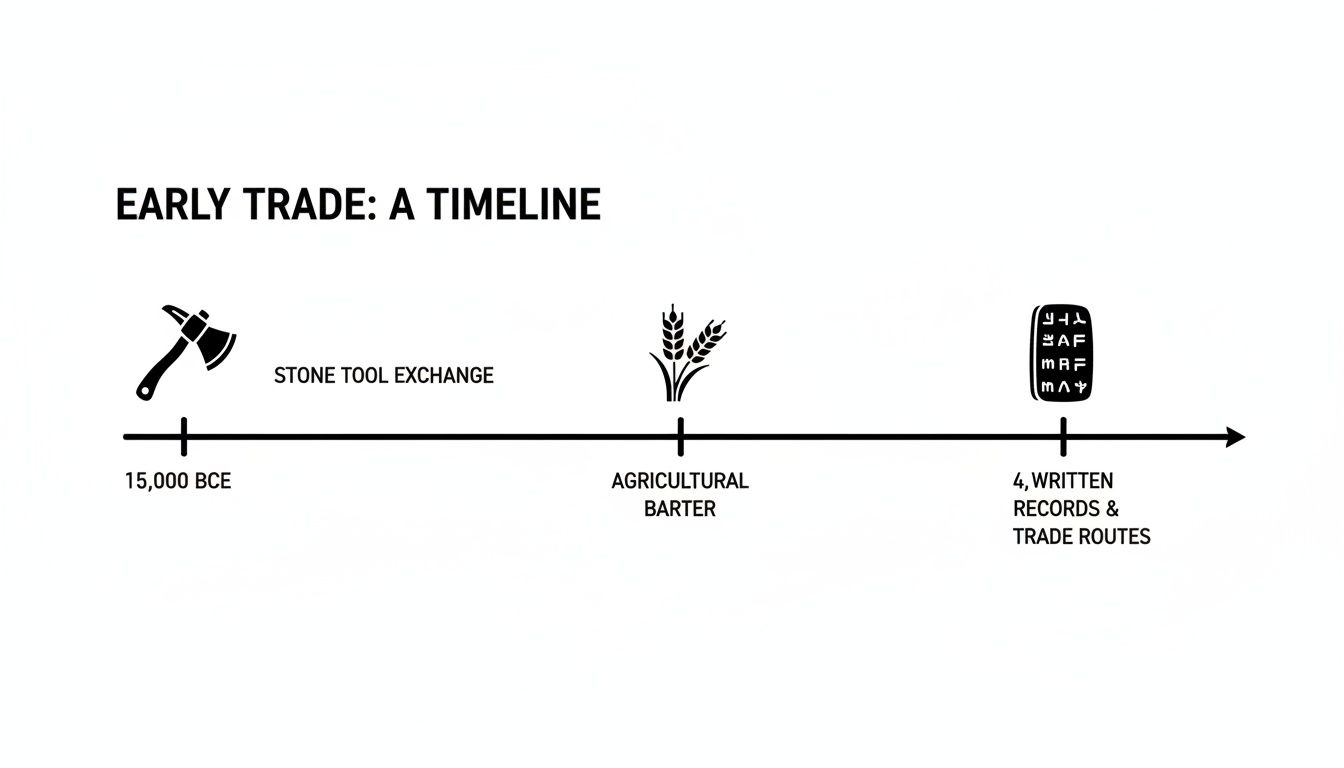
As you can see, the instinct to trade is deeply human. Evidence shows that early humans were swapping essentials like obsidian and flint over 150,000 years ago. By 4000 BCE, organized systems were already taking shape along the Tigris and Euphrates rivers in Mesopotamia. To dig deeper into this fascinating backstory, you can explore more about the origins and timeline of trade and how it evolved over the centuries.
The Birth of the First Organized Stock Exchanges

The leap from trading physical sacks of grain to trading abstract shares of a company was a massive one in our financial story. This change didn’t happen overnight. It grew out of the bustling port cities of Europe, where merchants were dreaming up ambitious global ventures that required more money than a few rich patrons could provide.
While informal markets had existed for centuries, the first truly modern stock exchange was born in 17th-century Amsterdam. The city was a global powerhouse, largely thanks to one of the most influential corporations in history: the Dutch East India Company (VOC).
The First Publicly Traded Company
The VOC needed staggering amounts of capital to bankroll its long, dangerous shipping expeditions to Asia. Rather than rely on a handful of wealthy investors, the company tried something radically new: it offered ownership stakes to the public. Anyone with the funds could buy a "share" and own a piece of the company.
You can think of it as the world’s first massive crowdfunding campaign. Each share gave its owner a claim on the company's future profits—and its risks. This single innovation created the world's first publicly traded company and, with it, the need for a central place to buy and sell these new paper assets. That place became the Amsterdam Stock Exchange, founded in 1602.
This was a game-changer. For the first time, wealth wasn't just tied to land or gold. It could be represented by a piece of paper—a share that could be bought and sold, its value shifting with the company's fortunes and the public's mood.
This idea of pooling capital and sharing risk became the blueprint for every public company that exists today. While historians debate the "true" first exchange—some point to a securities market in Bruges around 1409 CE or London's Royal Exchange—Amsterdam was where the trading of company shares was truly formalized. The Dutch East India Company issued 1,143,000 shares at 3,000 guilders each, a capitalization equivalent to an incredible $7.9 trillion today when scaled to the economy. For a deeper dive into these origins, you can explore some great resources on the evolution of trading exchanges.
The Model Spreads Across The Atlantic
A financial model this powerful couldn't stay in Amsterdam for long. The concept quickly jumped to London and, eventually, made its way to the young United States. In New York, the first brokers met informally under a buttonwood tree on what would become Wall Street, primarily to trade the new nation's government bonds.
This casual arrangement got an official upgrade on May 17, 1792, when 24 stockbrokers signed the Buttonwood Agreement. This simple document established a more organized system for trading securities, locking in commission rates and giving signatories preference in trades. That two-sentence pact was the seed from which the New York Stock Exchange (NYSE) would grow.
These early exchanges were so important because they introduced a few core principles that we still rely on:
- A central meeting place for buyers and sellers, which focused activity.
- Standardized rules to keep trading fair and transparent for everyone.
- A mechanism for price discovery, allowing the market to find a share's true value through open bidding.
By creating this structure, these organized markets built the predictable, rules-based environment that allows modern traders to analyze patterns and execute their strategies with confidence.
How Technology Transformed Trading Forever
As organized exchanges found their footing, the next big shift wasn't driven by new rules, but by a relentless quest for speed. The invention of the stock ticker in 1867 was the first real game-changer, letting price data zip across telegraph wires almost instantly. The telephone followed, giving brokers the power to place orders from cities far from the chaotic exchange floors.
But let's be clear—these innovations only sped things up for a privileged few. Real power was still clenched in the fists of floor traders who physically controlled the order flow. For the average person, the market remained a distant, intimidating world. The walls only started to come down with the arrival of the computer.
The Dawn of Electronic Trading
You can draw a straight line from the old way of trading to the new, and that line passes directly through 1971 with the launch of the NASDAQ. It was the world's very first electronic stock market. Unlike the NYSE, which was all about a physical trading floor, the NASDAQ was more like an early, specialized internet for stocks.
It was a computer network where dealers from anywhere in the country could post their bid and ask prices. Suddenly, a broker in Chicago could see the exact same prices as a broker in New York, completely shattering the geographic monopoly that traditional exchanges had enjoyed for centuries. This leveled the playing field in a way that was immediate and undeniable.
The 20th century turbocharged trading with technology, and NASDAQ’s 1971 launch as the first electronic over-the-counter market was a key moment. Within five years of its creation, trading volume on the OTC market surged by 300% as more than 2,500 stocks became accessible on computer screens. For more context on this period, you can discover more insights about the history of electronic trading.
Market Shocks Drive Innovation
Sometimes it takes a crisis to force real progress. The "Black Monday" crash of 1987 was exactly that—a massive wake-up call for the entire system. On October 19, the Dow Jones Industrial Average collapsed by 22.6% in a single session, a record that still stands. The panic exposed just how badly the system handled the flood of small retail orders.
In the aftermath, regulators stepped in. They mandated new systems to make sure small orders weren't left behind during a market meltdown. This gave rise to the Small Order Execution System (SOES), a mechanism that automatically routed a huge chunk of retail trades electronically. By 1990, SOES was already handling 70% of all retail trades, paving the way for the online brokerage boom that was just around the corner.
These are the pivotal moments that led directly to the power you have at your fingertips today. The ability to pull up a chart from your desk, apply indicators, and place a trade in seconds is the direct legacy of these breakthroughs. Today's tools simply build on that foundation, allowing you to filter thousands of stocks in an instant. For a practical example, see how this works in our guide on the best stock screener for swing trading.
The Rise of Algorithmic and High-Frequency Trading
Once computers could place trades instantly, the next logical step was to teach them when to place them. This leap gave us algorithmic trading, which is really just about giving a computer a specific set of marching orders.
At its core, an algorithm is just a pre-programmed "if-then" command. For instance: "If Apple's stock hits $250, buy 100 shares." Or, "If a stock falls below its 200-day moving average, sell everything." A computer can watch thousands of stocks at once and execute these rules flawlessly, 24/7, without a hint of fear or greed.
Trading on Steroids: High-Frequency Trading
Now, what happens when you take that basic concept and build a Formula 1 race car around it? That's High-Frequency Trading (HFT). This is a specialized form of algorithmic trading where billion-dollar firms use supercomputers and incredibly complex programs to execute millions of orders in the blink of an eye.
Speed is the only thing that matters here. These firms often set up their servers right next to the stock exchange's hardware—a practice called "co-location"—just to shave microseconds off the data's travel time. Their goal isn't to hold stocks for days or weeks; it's to profit from tiny, fleeting price differences that a human trader could never even see, let alone act on. This is where trading truly became a game of machines.
What Automated Trading Means for You
It's natural to hear about HFT and feel like you're outgunned. But here's the secret: for a savvy trader, these automated systems actually make the market more predictable, not less. The algorithms aren't guessing; they run on cold, hard math based on price, volume, and technical indicators.
In practice, this means automated systems often reinforce key technical levels. When a massive number of algorithms are all programmed to buy at a specific support level or sell at a known resistance level, their combined firepower makes those price boundaries stronger and more reliable.
This herd-like behavior from the machines has a powerful side effect on the market's structure:
- Adds Liquidity: By constantly placing buy and sell orders, HFT systems inject a staggering amount of liquidity into the market. This generally makes it easier for the rest of us to get our trades filled at fair prices.
- Defines Price Patterns: Their rule-based nature helps carve out the very support and resistance channels that we channel traders love. They essentially draw the lines on the chart for us.
- Creates Predictable Behavior: For traders who know what to look for, these algorithmically-driven price levels create clearer, more reliable opportunities for planning entries and exits.
The key takeaway is this: you're not competing against the machines. You're using the clear patterns they create to your advantage. By mastering the art of identifying these channels, you're essentially riding the powerful currents they generate. You can explore this and other powerful techniques by learning more about our advanced concepts for traders.
What History Teaches the Modern Trader in 2026
It’s easy to feel like trading in 2026 is a brand-new game, dominated by high-speed algorithms and blinking charts. But if you look past the technology, you’ll find that the real engine driving the market is the same one that has been running for centuries: human behavior.
Beneath it all, we’re still just wrestling with the timeless forces of supply and demand. The old caravan routes where merchants moved goods from areas of surplus to areas of scarcity weren't so different from the price channels you see on a chart. One was a physical path of value; the other is a digital one, carved out by the collective push and pull of buyers and sellers.
The Timeless Principles of Value and Demand
Think about it. The original shareholders in the Dutch East India Company bought into the venture with a simple hope: that demand for exotic spices from a faraway land would drive up the value of their shares. That same hope—and the anxiety that comes with it—is exactly what a trader feels today when a stock moves.
At its core, the principle has never changed. It doesn't matter if the asset is flint, tulip bulbs, government bonds, or a hot tech stock. An asset's worth is simply what someone else is prepared to pay for it. Grasping this simple truth gives you a powerful framework for cutting through all the noise of modern markets.
For a retail trader looking for a reliable edge, this history lesson is huge. It shows that value has always moved in defined ‘channels’ created by supply and demand. These are the same forces that create the support and resistance levels we trade in U.S. and Canadian stocks today. The early patterns of surplus goods finding a market are a direct ancestor of the disciplined buy-low, sell-high rhythms that let traders build wealth. You can dig deeper into the historical evolution of trade to see these patterns for yourself.
Applying Historical Wisdom to Your Strategy
So, what’s the takeaway for you, an individual trader trying to make sense of it all? It means you can anchor your strategy in principles that have been proven over thousands of years. Market behavior might seem random, but it’s often just history rhyming in a new context.
The real lesson is about discipline and pattern recognition. History shows that value ebbs and flows within predictable boundaries. A trader's job isn't to reinvent the wheel, but to get really good at spotting these recurring patterns and acting on them decisively.
When you ground your trading in these time-tested realities, you stop reacting emotionally to every market swing. You start operating with a clear, strategic mind. The long journey of trading isn't just a collection of interesting facts; it’s a mental model for building lasting success.
Here’s how these historical lessons become actionable insights for your trading today:
- Supply and Demand Are Everything: Every flicker of price on your screen is just a battle between buyers and sellers. Never lose sight of that.
- Channels Are Natural Formations: Just as water carves a riverbed, trading volume carves channels of support and resistance. Learning to see them is a fundamental skill.
- Human Nature Doesn’t Change: The fear and greed that fueled the very first stock market bubbles are just as potent today. They are the market's true engine.
Embracing this perspective is a huge step in your growth as a trader. To start connecting these ideas to your own process, check out our guide on the best way to learn stock trading. The tools change, but as history shows us, the game remains the same.
Frequently Asked Questions About Trading History
Let's tie all this history together. Here are a few common questions that come up when we look at how the past shapes our modern trading world. These quick answers should help solidify how centuries-old ideas are still at play every single day.
What Was The Very First Thing Ever Traded?
Long before any stock or bond existed, trade was about pure survival. The earliest evidence we have points back over 150,000 years, where prehistoric groups exchanged essentials. We're talking about things like high-quality flint and obsidian for making tools.
There was no profit motive here. This was a simple barter system, the world's first economy, driven by one thing: need.
When Did The First Stock Market Officially Open?
While people had been gathering to trade goods for centuries, the game truly changed in 1602 with the Amsterdam Stock Exchange. This is widely seen as the first modern stock market, and it was created for one specific purpose: to trade shares in the Dutch East India Company (VOC).
This was the first time a company offered ownership to the public, and the exchange created a centralized, regulated place to trade it. For a swing trader, it's fascinating to see how the auction systems in these early exchanges created predictable 'price channels'—a concept that directly mirrors the curated stock lists we analyze today for clear support and resistance levels. You can dig deeper into how these foundational trading structures evolved and see their modern influence.
How Did People Trade Before Computers?
It’s hard to imagine now, but trading used to be an incredibly physical, face-to-face job. Traders packed onto the floors of stock exchanges, using a frantic system of hand signals and shouts called "open outcry" to place their orders.
Information moved at a snail's pace. News arrived via messengers, then the telegraph, and eventually the stock ticker, which spat out prices on a long strip of paper. It was a chaotic, noisy, and personal system—a world away from the silent, instant execution we have at our fingertips today.
Does Understanding History Actually Help Modern Traders?
Absolutely. The technology has changed, but the engine driving the market hasn't: human psychology. Fear, greed, and the fundamental laws of supply and demand create patterns that have repeated for centuries.
By understanding how markets grew—from basic barter to organized exchanges and now to algorithms—you gain invaluable context. It helps you spot long-term trends, appreciate risk, and apply time-tested principles to today's incredibly fast markets.
Simply put, knowing the "why" behind the market's structure gives you a real strategic advantage.
At Channeling Stocks, we're firm believers that these timeless patterns are the secret to building a repeatable trading strategy. We deliver weekly curated lists of stocks moving in predictable channels, helping you apply historical wisdom to the modern market.