
Forget all the "get rich quick" noise you see on social media. If you're serious about learning to trade stocks, there's only one way that truly works: combining a solid education with disciplined practice. It's not glamorous, but it’s the only path to building a skill that can last a lifetime.
The Smartest Way to Start Your Trading Journey

Diving into the market without a plan is a recipe for disaster. I've seen countless new traders blow up their accounts because they treated it like a casino. Successful traders don't gamble; they execute a well-defined process. That process starts long before you ever place a trade with real money.
The bedrock of that process is education, but not the kind that has you memorizing hundreds of obscure indicators. Your focus should be on practical concepts you can apply directly to a price chart.
Building a solid foundation for your trading education is crucial. The table below contrasts a disciplined, structured approach with the common, high-risk path many new traders mistakenly take.
Core Pillars of a Successful Trading Education
| Pillar | Structured Approach (Recommended) | Unstructured Approach (High Risk) |
|---|---|---|
| Foundation | Master core concepts first (market structure, support/resistance). | Chase "hot tips" and complex, unproven strategies. |
| Practice | Use paper trading to test strategies and build discipline without risk. | Jump straight into live trading with real money, learning from costly errors. |
| Methodology | Develop a repeatable process for identifying and executing trades. | Make emotional, inconsistent decisions based on gut feelings or hype. |
| Risk Management | Learn and implement strict risk controls from day one. | Ignore or misunderstand the importance of stop-losses and position sizing. |
Following a structured path gives you a clear roadmap, helping you build skills systematically and avoid the devastating financial and emotional setbacks that derail most aspiring traders.
Mastering Market Mechanics
Your first real job as a student of the market is to learn how to read a price chart. A chart tells a story, and you need to understand the language of price action.
Before you do anything else, get comfortable with these core skills:
- Identifying Market Structure: Is the stock in an uptrend (making higher highs and higher lows), a downtrend, or just chopping sideways? This is the most basic, yet most important, context.
- Understanding Support and Resistance: You have to be able to spot the price levels where buying or selling pressure has historically shown up. These are the zones where battles are won and lost.
- Learning Core Order Types: Knowing the difference between a market order, limit order, and stop-loss order isn't optional. It's fundamental to managing your entries, exits, and—most importantly—your risk.
The objective is not to predict the future with 100% accuracy. It's to identify high-probability setups where your potential reward is significantly greater than your risk. This is where finding predictable patterns, like stocks moving in clean channels, gives you a real, repeatable edge.
The Power of Practice
Once you start getting a handle on the theory, you need to apply it immediately in a risk-free environment. This is where a trading simulator, or paper trading, becomes your best friend. It’s your lab.
Paper trading lets you test your ideas, make all the classic rookie mistakes without losing a dime, and start building the emotional fortitude needed to handle the pressures of a live account.
This blend of financial education and simulated practice is a proven formula. In fact, one study found that a person's financial literacy and experience with online platforms explains 89.7% of the variance in their willingness to use mobile stock trading tools. People who understand the concepts are better at weighing risks and are more likely to use efficient online platforms. You can dig into the full findings on these behavioral factors yourself. It’s a powerful reminder of why starting with a structured education is so critical.
Building Your Knowledge Base with Core Trading Concepts
Jumping into the market before you understand the fundamentals is one of the fastest ways to lose money and confidence. Before you even touch a paper trading account, you need to build a solid knowledge base.
Don't worry, this isn't about memorizing hundreds of obscure candlestick patterns or complicated indicators. The key is to focus on the handful of core concepts that truly drive price movement. Get these right, and you'll have a framework for everything else.
First, Learn to Read the Market’s Mood
Whenever you pull up a stock chart, the very first question you should ask is: What's the big picture? A stock’s price can really only do one of three things. Figuring out which one is happening gives you critical context for any potential trade.
- Bull Market (Uptrend): You’ll see a clear pattern of higher highs and higher lows. This is the market’s green light, showing that buyers are firmly in control.
- Bear Market (Downtrend): The opposite is true here. Prices are making a series of lower highs and lower lows. This is a sign of pessimism, where sellers have the upper hand.
- Sideways Market (Consolidation): The price is just bouncing around in a defined range, not making any real progress up or down. Buyers and sellers are at a standstill, waiting for the next move.
Identifying the current structure is like checking the weather before you head out. It’s foolish to look for buying opportunities in the middle of a downtrend, just as it’s risky to bet against a powerful uptrend.
Master the Tools of the Trade: Order Types
Placing a trade is so much more than just hitting the "buy" button. The type of order you use is your primary tool for controlling your entry, your exit, and—most importantly—your risk. A simple misunderstanding here can lead to you paying way more for a stock than you wanted or taking a much bigger loss than you planned for.
Every trader needs to know these three non-negotiable order types like the back of their hand:
- Market Order: This tells your broker to buy or sell immediately at the best price available right now. It's all about speed, but be careful—in a fast-moving stock, the price you get might be different from the price you saw a second ago. That's called slippage.
- Limit Order: This gives you precision. You set a specific price, and the order will only execute if the stock hits that price or better. A buy limit is set below the current price, and a sell limit is set above. It's how you ensure you don't overpay.
- Stop-Loss Order: This is your safety net. It's an order you place ahead of time to automatically sell your position if the stock drops to a certain price. Think of it as your emergency brake for limiting losses when a trade goes against you.
A simple way to think about it: A market order says, "Get me in now, I don't care about the exact price." A limit order says, "I'm only interested at this price." And a stop-loss is your pre-planned escape hatch.
The Foundation of All Technical Analysis: Support and Resistance
If you only learn one technical concept, make it this one. Support and resistance are the cornerstones of reading a chart. They are simply levels where the battle between buyers (demand) and sellers (supply) has previously been won or lost.
Support is a price floor. It's a zone on the chart where buyers have historically stepped in, overwhelming sellers and pushing the price back up.
Resistance is a price ceiling. It's a level where sellers have proven to be stronger, halting a rally and causing the price to turn back down.
Once you can spot these areas, you can start building logical trade ideas. For instance, a classic strategy is to look for a buy entry near a strong support level, since the odds suggest buyers might show up there again. You can see more detailed examples in our guide on how to read stock charts for beginners.
Nailing down these core ideas is the true starting line for any serious trader.
Turning Knowledge into Skill with Paper Trading

All the theory in the world gets you to the starting line, but practice is what gets you across the finish. This is where paper trading—using a trading simulator with fake money—becomes the single most valuable part of your education. It’s how you bridge the enormous gap between knowing what to do and actually doing it when the pressure is on.
I like to think of it as a flight simulator for traders. You can crash and burn a hundred times, and it won't cost you a dime. This risk-free environment is where you test your understanding of support and resistance, rehearse your strategies, and make all the classic rookie mistakes without that gut-wrenching feeling of watching your real money disappear.
Setting Up Your Practice Environment
Most modern brokerage platforms offer a paper trading account, and your first job is to make it feel as real as possible. Don't start yourself off with a million dollars if you only plan to trade with $5,000. The goal is to build habits that will transfer seamlessly when you go live.
Once you’re set up, forget about the "profits." Your focus is on the process. You’re here to experiment, learn, and build rock-solid discipline.
Don't underestimate this simulation phase. A massive study of over 13,730 students found that while watching experienced traders and discussing ideas boosted trading activity, it didn't guarantee success. In fact, more experienced students often showed poorer results, proving that just being busy isn't the same as being skilled. This is exactly why a dedicated practice space, like the paper trading areas we offer at Channeling Stocks, is so crucial. Risk-free rehearsal is what builds real competence. You can dig into the full research on how education shapes trader participation if you want to see the data for yourself.
What to Focus on During Paper Trading
Your time in the simulator needs structure. Don't just place random trades on a whim. Instead, you should be laser-focused on a few key objectives.
- Strategy Rehearsal: Stick to your rules. If you're practicing a channel trading strategy, you only take a trade when a stock is testing a clear support or resistance level. No exceptions.
- Order Execution: Get comfortable placing limit orders to enter at your price. Even more importantly, practice setting your stop-loss order immediately after your entry order is filled. Every. Single. Time.
- Emotional Management: Notice how you feel when a trade goes against you, or when you miss what looked like a perfect setup. The goal is to separate your emotions from your decisions—a skill that's much easier to learn when real money isn't on the line.
Your trading simulator is your laboratory. It’s where you build confidence. When you can consistently spot repeatable patterns and execute your plan without hesitation, you're building the muscle memory you absolutely need for live trading.
Your Most Powerful Tool: A Trading Journal
If you do nothing else, do this: keep a detailed trading journal. This is not optional. Your journal is the raw data that will expose your weaknesses and highlight your strengths. It’s how you find your edge.
For every single paper trade, you need to log the following:
- The Setup: Why did you take this trade? Paste in a screenshot of the chart with your support and resistance lines clearly marked.
- The Entry: Note the exact entry price and the date.
- The Exit: Record your exit price, whether it was your profit target or your stop-loss.
- The Rationale: Write down your thoughts. Were you disciplined? Did you follow your plan? If not, what happened? Be honest with yourself.
- The Outcome: The final profit or loss on the trade.
After just 20-30 trades, you'll have a rich dataset to review. Are you cutting your winners too short? Are you moving your stop-losses? Your journal will give you the hard, objective answers you need to get better.
Platforms like Channeling Stocks can seriously speed this up. By giving you curated lists of stocks already in a channel, you can skip hours of searching and dedicate your time to a high volume of practice trades on high-probability setups. This kind of focused repetition is what turns a novice into a confident trader.
Developing Your First Repeatable Trading Strategy
After you’ve put in the reps in a paper trading account, it’s time to build a real, repeatable strategy. I’ve seen it a thousand times: bright people get into trading, but they fail because they don't have a process. They’re chasing hot stocks on social media, swapping indicators every other day, and letting their emotions call the shots. That’s a fast track to an empty account.
If you want to survive your first year and actually build a skill, you need a simple, logical system. For my money, one of the best places for a new trader to start is with channel trading. It’s an approach that gives you a clear map, cutting out the guesswork and emotional chaos that trips up so many.
What Is a Price Channel?
Think of a price channel as a river with solid banks. A stock’s price is just flowing between two parallel trendlines, creating a predictable path.
- The Lower Trendline (Support): This is your floor. It's a price level where buyers consistently show up, catching the stock before it falls further and pushing it back up.
- The Upper Trendline (Resistance): This is the ceiling. It's where sellers tend to take over, stopping the stock's climb and sending it back down toward support.
When a stock gets locked into one of these channels, its behavior becomes surprisingly predictable. It bounces off the floor, rises to the ceiling, and repeats. This is the perfect environment for swing trading, where your goal is to capture one of those "swings" from low to high.
The Core Strategy: Buy Low, Sell High, Systematically
The beauty of a channel trading strategy is its simple logic: your plan is to buy the stock when it’s near the support trendline and sell it when it nears the resistance trendline. That’s it. This isn't about some secret formula; it’s about building a methodical trading plan.
Instead of gambling on where a stock might go, you're reacting to where it already is. You’re working within a visible, established pattern, which immediately gives you an edge. This systematic process is what separates traders who last from those who burn out in a few months.
Key Takeaway: A repeatable strategy is your best defense against emotional trading. By zeroing in on a clear pattern like a price channel, you replace fear and greed with a logical, step-by-step plan for every single trade.
Your goal isn't to be right 100% of the time—that's impossible. It's to execute a strategy that puts the odds in your favor over a long series of trades. You can see how this fits into a bigger picture by exploring our other swing trading strategies.
To make this crystal clear, here’s a simple checklist that breaks down the entire process from start to finish.
Channel Trading Strategy Checklist
| Step | Action | Key Consideration |
|---|---|---|
| 1. Identification | Find a stock trading in a clear, parallel channel. | The channel should have at least two touches on both support and resistance. |
| 2. Entry Plan | Wait for the price to approach the support trendline. | Don't just buy at the line. Wait for confirmation, like a bullish candle. |
| 3. Risk Definition | Set a stop-loss order just below the support line. | This is your exit if the pattern fails. This decision must be made before you enter. |
| 4. Target Setting | Place a limit order to sell just below the resistance trendline. | This locks in profits before sellers arrive. Don't get greedy. |
| 5. Execution | Enter the trade with your pre-defined entry, stop, and target. | Once the plan is set, your only job is to follow it without emotion. |
| 6. Review | After the trade closes (win or loss), review your execution. | Did you follow your plan? What could you improve for the next trade? |
This checklist turns a complex activity into a manageable process. You're not guessing; you're executing a plan.
Validating any strategy is absolutely critical. A 2014 research paper on trading strategies found that without proper statistical adjustments, performance can be hugely exaggerated. In fact, some strategies saw their supposed gains drop by as much as 100% when tested on new data. This is why random strategies you find online often fail miserably in live markets.
It's also why using a service like Channeling Stocks—which is built on over 25 years of real-world pattern recognition—can be a powerful shortcut. The channels we identify are already vetted. If you want to dive into the data, you can read the full research on adjusting for false discoveries in trading strategies to see why this matters so much.
Your 90-Day Plan to Trading with Confidence
Real, lasting progress in trading doesn't just happen—it's built. You need a deliberate plan. We’ve mapped out a 90-day curriculum to take you from knowing nothing to trading with a repeatable, battle-tested strategy. We'll break this journey down into three distinct, manageable phases.
Think of it like this: the first month is all about deep immersion in the core concepts. The second is for disciplined practice. And the third is where you start refining your process using your own performance data. This staged approach is designed to build your skills methodically and prevent you from getting overwhelmed.
Days 1-30: Building Your Foundation
Your first 30 days are dedicated entirely to education. That means no trading. Not even with a simulator. Your single mission is to absorb the fundamental concepts of trading before you ever risk a dime or even click a button.
Your daily habit should be a mix of reading, watching videos, and most importantly, studying historical charts. Pour your energy into these three pillars:
- Market Structure: You need to be able to spot uptrends, downtrends, and sideways ranges on any chart, in any timeframe. This is your map.
- Support and Resistance: This is non-negotiable. Spend hours just marking up old charts. Train your eye to see these critical price levels until it becomes second nature.
- Order Types: Get to know the mechanics of market, limit, and stop-loss orders. You must understand exactly when and why you'd use each one.
I can't stress this enough: fight the urge to jump ahead. The single biggest mistake new traders make is rushing into the "action" without a rock-solid understanding of these basics. One month spent here will save you years of frustration and costly errors down the road.
Days 31-60: Disciplined Rehearsal
Now it's time to move from theory to practice. This entire month will be spent in a paper trading account, like the one offered by TD Ameritrade's thinkorswim or TradingView. Your only goal is to execute your channel-based strategy with perfect discipline. Real money is completely off the table.
You are not here to make "paper profits." You are here to rehearse a process. Focus on your execution, not the outcome.
The point of paper trading isn't to prove you can make money. It's to prove you can follow your rules. If you can't stick to your plan with fake money, you have zero chance of doing it when real capital and emotions are on the line.
This is the simple, three-part process you’ll be drilling over and over again for every single trade.
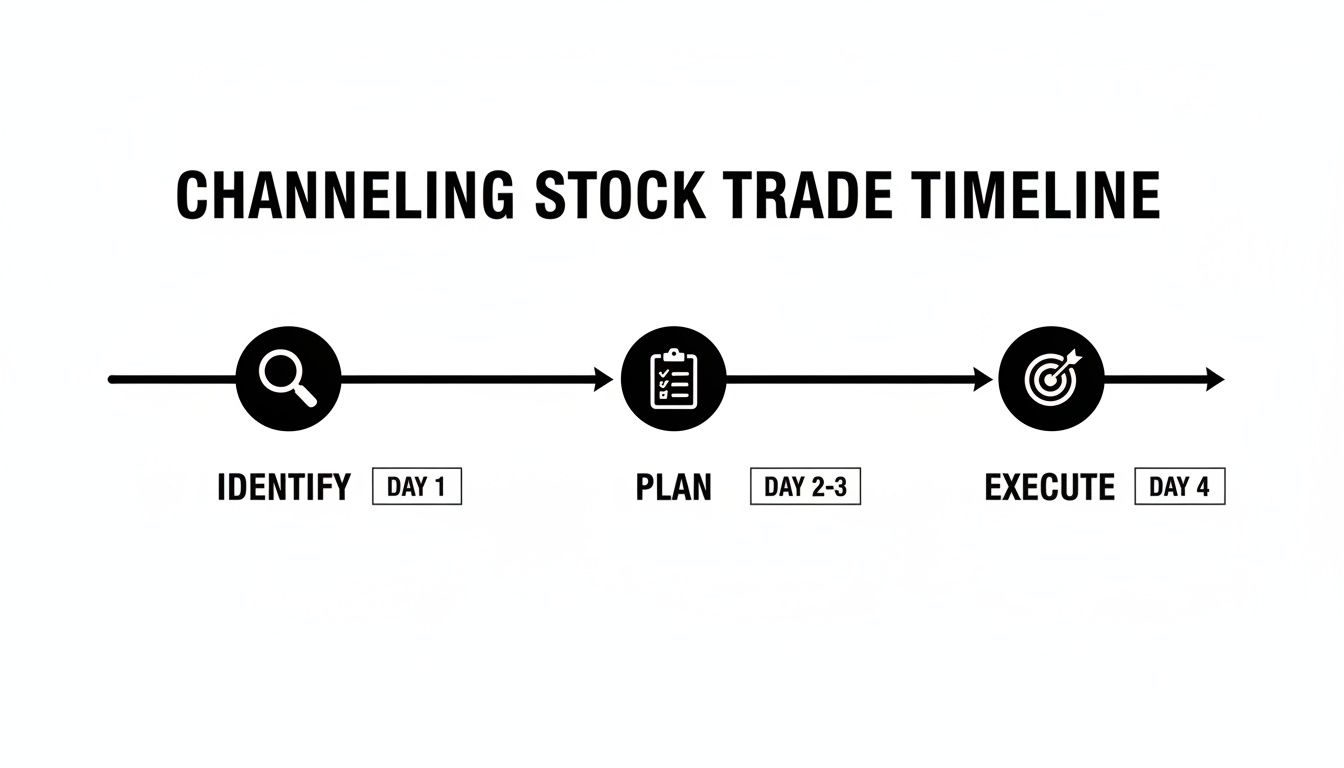
While the graphic shows a straight line, your real job is to make each step—identifying a valid channel, planning your entry and exits, and executing flawlessly—a subconscious habit.
This is where a service like Channeling Stocks can be a massive shortcut. Instead of spending 80% of your time just looking for stocks that are channeling, you get a pre-vetted list. This lets you spend 100% of your practice time on the things that actually build skill: execution, risk management, and journaling.
Days 61-90: Refining Your Edge
In your final 30-day block, you'll put on your data analyst hat. Your trading journal is now your most valuable asset. The goal here is to dig into your performance, find your personal strengths and weaknesses, and start sharpening your strategy. You'll keep paper trading, but now with a laser focus on optimization.
Go back and review every trade you logged last month. Be brutally honest and ask yourself some hard questions:
- Where am I consistently messing up? Am I moving my stop-losses? Bailing on trades too early?
- Which setups are actually working for me? Do I have a better win rate with wider or tighter channels?
- Is my journal telling me I’m following my plan? The data doesn't lie.
The answers will guide your adjustments. For example, you might discover that your best trades happen on channels where the price has clearly touched both the upper and lower bands at least three times. Great—make that a new, non-negotiable rule in your trading plan.
By the end of this 90-day plan, you will have accomplished what 90% of aspiring traders never do. You'll have a real knowledge base, a history of disciplined practice, and a data-driven strategy that you can call your own. Only then can you feel truly ready to consider trading with a small amount of real money, because you'll finally have a process you can trust.
Answering Your Top Trading Questions
When you’re just starting out, the world of trading can feel like a minefield of unanswered questions. That's totally normal. Getting straight answers is the first step toward building real confidence. Let's tackle some of the big questions I hear from new traders all the time.
How Much Money Do I Really Need to Start?
This is the big one, isn't it? The good news is, you probably need less than you think. With most major brokers dropping their commissions to zero and offering fractional shares, you can technically open an account and buy something with $100.
But let's be realistic. A more practical starting point is somewhere between $500 and $2,000. Why? Because it gives you enough breathing room to buy a few different stocks, so one bad trade doesn't wipe you out. It also provides a small cushion to handle the small losses that are an unavoidable part of learning the ropes.
A word of caution: Only trade with money you are fully prepared to lose. This capital should be completely separate from your emergency fund, retirement savings, or the money you need for your monthly bills. No exceptions.
Can I Actually Teach Myself to Trade Stocks?
Yes, you can. Without a doubt. Thanks to the internet, we have access to more quality financial education than any generation before us. With enough discipline, you can absolutely learn market mechanics, technical analysis, and risk management on your own.
The trick is to be methodical. Don't just bounce from one "guru" on YouTube to the next. Find a single, repeatable strategy—like the channel-based approach we've been discussing—and commit to mastering it.
If you're going the self-taught route, you need a plan.
- Block Out Study Time: Treat it like a college course. Dedicate specific hours each week to focused learning.
- Practice Deliberately: Your first month (at least) should be in a paper trading simulator. Drill your chosen strategy relentlessly.
- Review Everything: Keep a detailed trading journal. Track your wins, your losses, and especially your mistakes. You have to be brutally honest with yourself here.
Teaching yourself takes a ton of discipline, but pulling it off is one of the most rewarding things you can do.
Honestly, How Long Does This Take?
Learning to trade is a journey, not a weekend project. You can pick up the basics in a few weeks, but reaching a point of consistent profitability takes time. For most traders, expect a solid 6 to 12 months of dedicated effort before you start to feel genuinely competent.
Our 90-day roadmap is designed to give you a powerful head start, but it's just that—a start. The market is the ultimate teacher, and even the pros are constantly adapting. Be patient, trust the process, and focus on making small, steady gains in your skill set, not your account balance.
What's the Best Way to Learn Without Losing My Shirt?
The answer is simple, and it's non-negotiable: paper trading. A trading simulator is your personal, risk-free laboratory. It's the place where you can test your strategies, follow your rules, and make all the classic rookie mistakes without losing a single dime.
Think of it like a flight simulator. You'd never want a pilot flying your plane without them having spent hundreds of hours in a simulator first. You should treat your hard-earned capital with that same level of respect.
By practicing in a simulated environment, you build the muscle memory and emotional control you'll need for live trading. You'll learn what it feels like to follow a plan, take a small, disciplined loss, and move on to the next trade—all without the fog of fear and greed that real money brings.
The entire Channeling Stocks platform was built to shorten this learning curve. Instead of spending hours just trying to find a good setup, you get a curated list of channeling stocks delivered every week. This lets you put all your energy into what really matters: practice and execution. Start your free trial at Channeling Stocks and begin building your trading skills the right way.